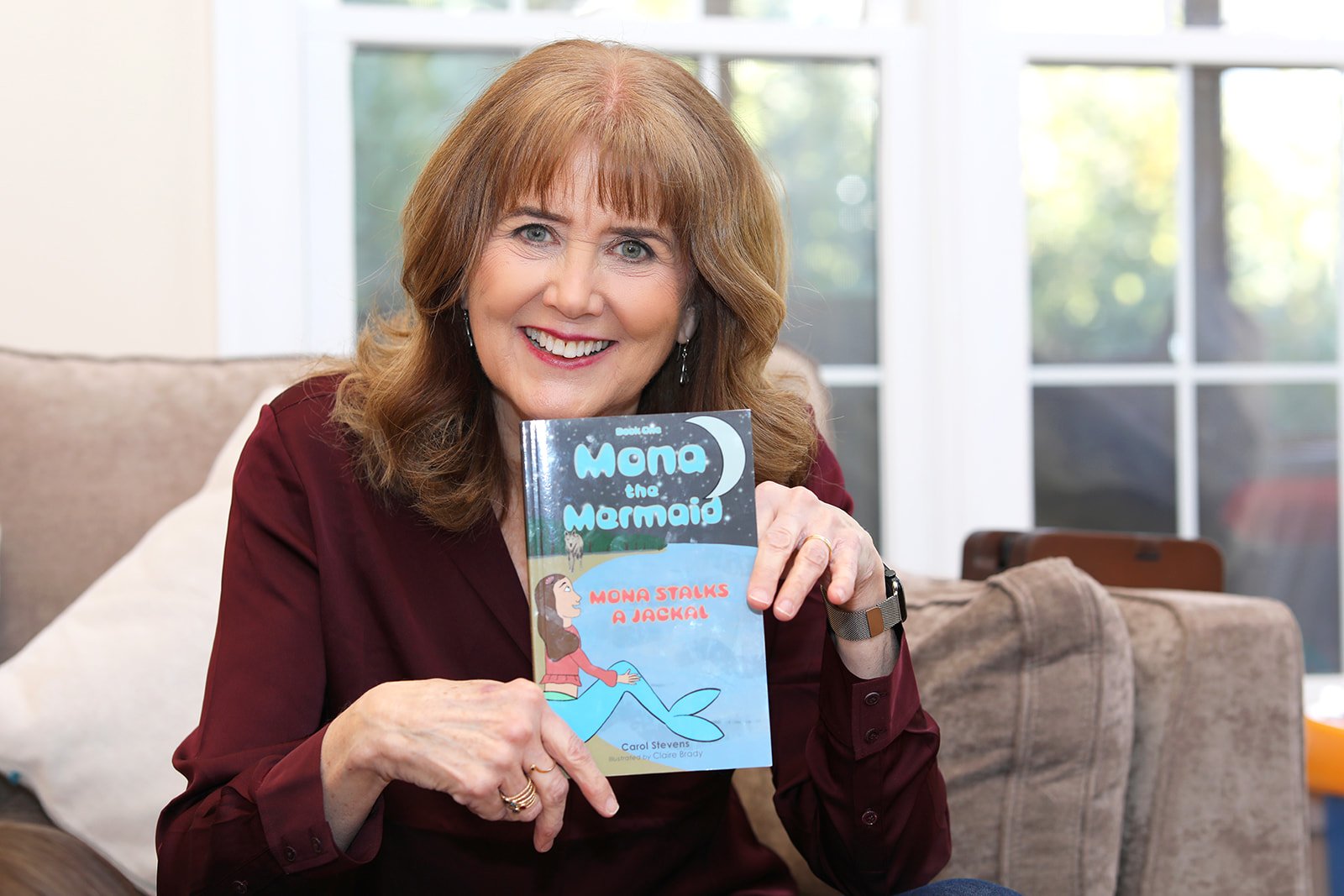
An interview with Carol Stevens
Before writing children’s books you were a journalist who worked at a wide range of national newspapers and magazines. What accounts for the career pivot from writing about elections and wars to mermaids?
Journalism is a great career. There’s no more exciting place than a newsroom on election night.
But fiction has always been my great escape. I love reading it and writing it.
For the past eight years, I’ve taught creative writing to adults with the Arlington County (VA) Public School System. A few years ago, I decided it was time for me to write my own books.
Why children’s books? And why this particular genre?
I’ve always loved children’s early chapter books, dating back to my childhood. These are not easy readers so much as books with a more involved plot and well-developed characters.
I never stopped reading early chapter books. Revisiting my favorite books by Judy Bloom, Beverly Cleary and Kate DiCamillo comforts me even as an adult.
I discovered a fun new world of early chapter books through my children and, now, my grandchildren: the Orson Eerie series, BatCat, the Piper Green and the Fairy Tree series, Dragon Masters, and The Never Girls books.
Ages five to 10-ish are a magical time. Children can follow the plot of a chapter book, whether it is read to them or they are reading the book themselves.
So how did you come to write about mermaids?
Mona the Mermaid, specifically, was inspired by stories my husband, Erik Brady, used to make up on the fly when our family vacationed along the Ontario shores of Lake Erie in an area named Crescent Beach.
The stories were never written down. But over the years they were frequently requested by our children, nieces, nephews and grandchildren.
A few years ago, my daughter and her family couldn’t join us at Crescent Beach. She suggested that I write a Mona the Mermaid story for her children that they could enjoy from home.
Each day I wrote a chapter of Mona the Mermaid: Mona Stalks a Jackal. Her two children were exacting editors. If I hadn’t emailed my chapter by 5 p.m. each day, I would get calls from them informing me I was tardy.
We all enjoyed the process so much that by the end of the vacation, I’d completed book one of Mona the Mermaid.
Book One? Does that more Mona the Mermaid books are in the works?
Absolutely! I hope to release Mona the Mermaid: Mona Saves Niagara Fallslater this year. And several more Mona books are in various stages of development.
Tell us about the illustrator.
I’m happy to! My daughter, Claire Brady, is a talented artist. When she volunteered to illustrate Mona Stalks a Jackal, I jumped at her offer. It’s fun to collaborate with her and see how she illustrates my words.
What is the plot of Mona the Mermaid: Mona Stalks a Jackal?
A huge storm washes young Mona up on the shores of Crescent Beach. Although she is injured and alone, the creatures of Crescent Bay become her close friends and family. They help her recover and find a lovely place to live. They even decorate her house and make her a comfy bed out of Zebra Mussel shells.
But life is not perfect at Crescent Beach. Over the next few years, Mona sees that the creatures are terrified of a jackal who prowls the shoreline.
Mona is sad that her friends are afraid of the jackal. She decides she is going to protect them. First, she learns as much as she can about jackals. Then she tracks down the jackal late one night.
It doesn’t go well. In fact, she ends up with a punctured tail!
But Mona doesn’t give up: One stormy night, Mona accepts the jackal’s invitation to talk.
Is this a mistake? Or can Mona convince the jackal to be friends?
I don’t want to give away the ending. Let’s just say that the meeting wasn’t what Mona expected. In the end, the young mermaid learns a lot about honesty, friendship and the two sides to most stories.
What’s Mona the Mermaid like?
Mona is a busy eight-year-old mermaid. She enjoys the underwater classroom where she attends school. She counts the many creatures of Crescent Bay and Crescent Beach as her close friends. She is determined and doesn’t give up.
Like the rest of us, Mona isn’t perfect. She sometimes ignores instructions or takes dangerous risks. And she can be quick to anger when things don’t go her way.
Lucky for the creatures of Crescent Beach and Crescent Bay, Mona is a good and loyal friend who isn’t afraid to be honest with them.
What lessons can readers learn from Mona the Mermaid: Mona Stalks a Jackal?
I believe children’s books should entertain and not lecture. But Mona the Mermaid does realize some important truths during her dealings with the jackal:
You don’t have to be brave to act brave.
Not all answers can be found in books.
Things aren’t always what they seem.
Any creature can behave badly when they feel trapped.
And, of course, to treat others the way you want to be treated.
And what lessons did you learn from writing Mona the Mermaid: Mona Stalks a Jackal?
My most delightful discovery was that my young grandchildren were excellent editors and beta readers. They weren’t shy about pointing out discrepancies and errors. For instance, one granddaughter, who was then four, informed me that in one scene I had confused predator with prey. She was right!